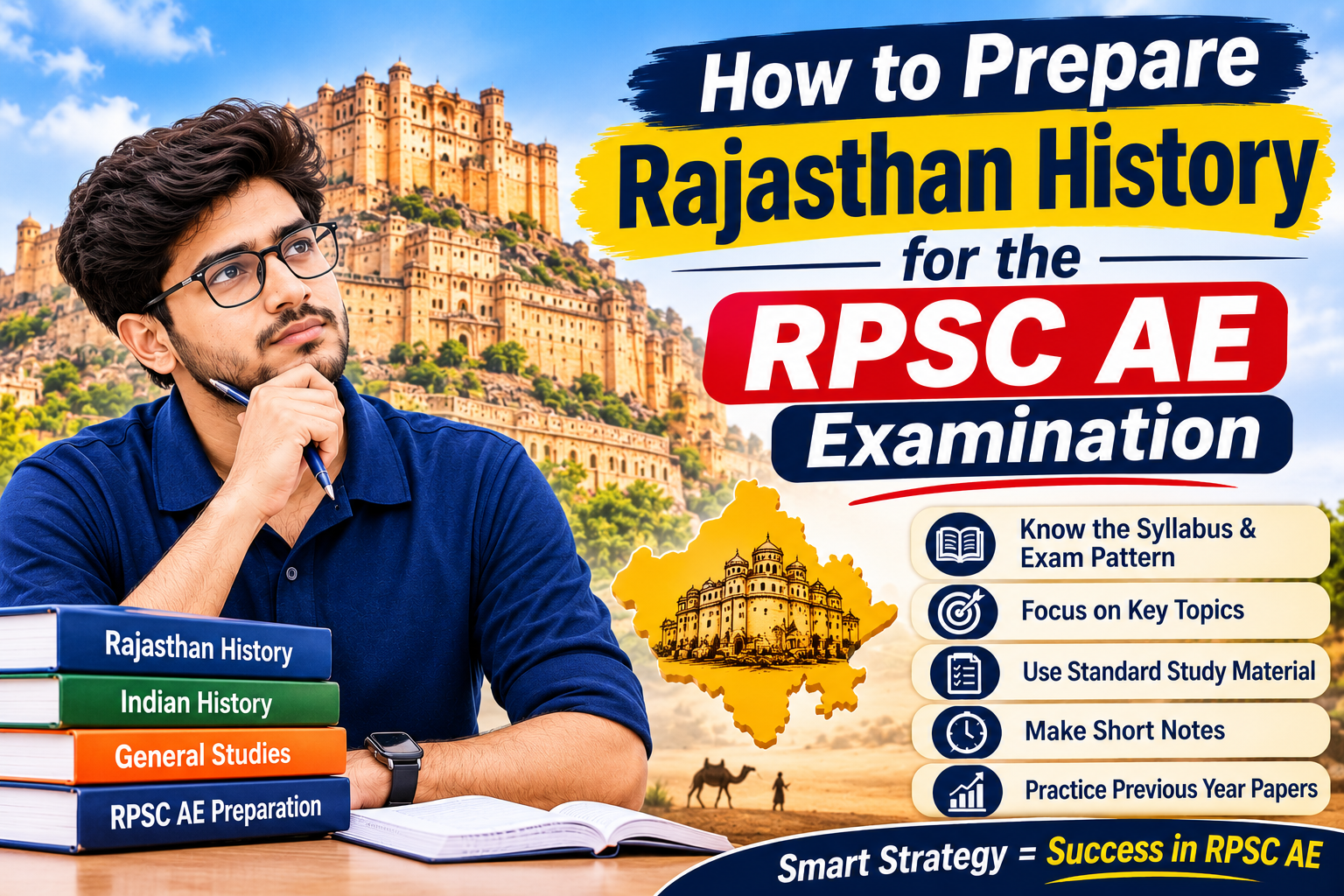
Preparing for the RPSC Assistant Engineer examination requires a balanced approach towards technical subjects and general knowledge. Along with engineering concepts, candidates should understand the importance of Rajasthan-specific topics, including history, culture, geography, and heritage, wherever they are included in the applicable examination syllabus. Rajasthan History is an important subject for aspirants because it provides knowledge about the state's historical development, major kingdoms, rulers, freedom movements, important battles, and cultural contributions. However, studying history without a proper strategy can become challenging because the subject contains numerous dates, events, personalities, and historical developments that candidates need to remember.
For candidates preparing for the RPSC AE Exam, understanding Rajasthan History through a structured study plan can make preparation more organised and effective. Instead of memorising every historical detail, aspirants should focus on syllabus-based learning, important historical events, chronological understanding, regular revision, and practice questions. Whether you are beginning your RPSC AE Preparation or revising the subject before the examination, a clear strategy can help improve your understanding and confidence. ZoneTech aims to support competitive examination aspirants through structured learning and preparation guidance, helping students develop a disciplined approach towards subjects that form part of their examination syllabus.
Before starting Rajasthan History, candidates should understand the latest RPSC Assistant Engineer examination syllabus and identify the topics relevant to their preparation. Studying without checking the official syllabus can lead to unnecessary effort and confusion. The syllabus should be your starting point because it helps you understand the examination structure, subject requirements, and areas that deserve attention.
Candidates should download the latest official notification and syllabus from the Rajasthan Public Service Commission website. Check whether Rajasthan History is included in the relevant examination paper or section and identify the prescribed topics. The syllabus and examination pattern may vary between recruitment cycles, so aspirants should not depend entirely on older study material. A syllabus-based approach helps candidates organise their preparation and spend more time on relevant subjects instead of collecting information without a clear direction.
Ancient Rajasthan provides a foundation for understanding the historical development of the region. Candidates should study important archaeological sites, early settlements, ancient cultures, and historical evidence associated with Rajasthan. These topics help explain how communities developed, how people lived, and how trade, agriculture, and cultural practices evolved over time.
Important areas to understand include the Kalibangan archaeological site, Ahar culture, Ganeshwar-Jodhpura culture, and other significant archaeological findings associated with the region. Rather than memorising names individually, candidates should understand the historical importance of each site, its geographical location, and the type of archaeological evidence discovered there. Creating a comparative chart of important sites, their locations, and major findings can make revision easier. For effective RPSC AE Preparation, students should connect historical facts with their context because understanding the background often makes information easier to remember.
The history of Rajasthan is closely associated with several Rajput dynasties and regional kingdoms. Their political development, administration, military achievements, architecture, and cultural contributions are important areas for students studying the state's history. Candidates should understand the major ruling families and the regions associated with their historical influence.
Important dynasties and kingdoms to study include the Guhilas of Mewar, Rathores of Marwar, Kachwahas of Amber and Jaipur, Chauhans of Ajmer, and other prominent ruling houses. Focus on important rulers, their contributions, major conflicts, administrative developments, and historical significance. Do not attempt to memorise every ruler's name in one sitting. Instead, prepare dynasty-wise notes that connect rulers with important events and achievements. This approach creates a clearer understanding of Rajasthan's political history and supports better factual recall during examination preparation.
Learning about important rulers is an essential part of Rajasthan History preparation. Candidates should study historical personalities not only by remembering their names but also by understanding their contributions to administration, warfare, culture, architecture, and regional development. This makes it easier to distinguish between rulers who belonged to different dynasties and historical periods.
For example, Maharana Kumbha is associated with significant architectural and cultural contributions, while Maharana Pratap is remembered for his resistance against Mughal expansion and the Battle of Haldighati. Rao Jodha is associated with the establishment of Jodhpur, and Sawai Jai Singh II is known for founding Jaipur and his contributions to astronomy and urban planning. Students should prepare short notes containing each ruler's dynasty, period, major achievements, important battles, and associated monuments. Such organised notes can be revised quickly during the final stages of the RPSC AE Exam preparation.
Historical battles and political events are frequently studied because they help explain changes in regional power, administration, and political relationships. Candidates should understand the background, participants, outcomes, and historical importance of major battles connected with Rajasthan. Memorising only the name of a battle may not be enough to develop a complete understanding of the topic.
Some important events to study include the Battle of Haldighati, the Battle of Khanwa, and significant conflicts involving the major kingdoms of Rajasthan. Understand the historical context, the rulers involved, the opposing forces, and the consequences of each event. Prepare a chronological timeline to arrange battles and major political developments in their correct historical sequence. This method can reduce confusion between similar events and help candidates revise historical developments more effectively.
The freedom movement in Rajasthan is another important area of regional history. Candidates should understand the contribution of freedom fighters, social reformers, local organisations, and public movements that played a role in political and social change. Rajasthan's freedom struggle included several movements against princely-state administration, social inequalities, and colonial influence.
Students should study important movements such as the Bijolia movement, Begun movement, and other peasant and tribal movements associated with Rajasthan. Personalities such as Vijay Singh Pathik, Manikya Lal Verma, Arjun Lal Sethi, Kesari Singh Barhath, and Govind Guru deserve attention while preparing relevant topics. Understand the causes of these movements, their leaders, the communities involved, and their outcomes. Making separate notes for freedom fighters and important movements can help candidates connect personalities with historical events and avoid mixing up their contributions.
Rajasthan is widely recognised for its forts, palaces, temples, and other architectural heritage. Historical monuments are important because they represent the political, cultural, artistic, and architectural development of different periods. Candidates should learn the names of major monuments, their locations, historical associations, and important architectural features.
Some well-known examples include Chittorgarh Fort, Kumbhalgarh Fort, Mehrangarh Fort, Amer Fort, Jaisalmer Fort, and Ranthambore Fort. Students should also understand the historical importance of places such as Hawa Mahal, City Palace Jaipur, and other important heritage structures. Instead of preparing isolated lists, connect each monument with its associated ruler, dynasty, location, and historical period. A map-based revision method can also help candidates remember where important forts and historical sites are located across Rajasthan.
Although the main focus of this blog is Rajasthan History, aspirants should also understand the relationship between historical developments and the state's cultural traditions wherever these topics are part of the official syllabus. Rajasthan's cultural heritage includes traditional paintings, folk music, folk dances, handicrafts, fairs, festivals, and architectural styles that developed across different regions.
Candidates can study traditional art forms such as Phad painting, miniature painting, and other regional painting traditions. Important folk dances, musical instruments, and cultural practices should also be understood through their regional associations. For example, Ghoomar and Kalbelia are well-known traditional dance forms of Rajasthan. Students should prepare concise notes about the origin, characteristics, and cultural significance of these traditions. Understanding the background of cultural practices makes the subject more interesting and improves the ability to recall related facts.
Selecting appropriate study material is essential for effective examination preparation. Candidates often collect too many books, PDFs, online notes, and reference materials, which can create confusion and make revision difficult. A better strategy is to select a limited number of reliable resources and study them consistently.
NCERT history textbooks can help students develop a basic understanding of historical concepts and chronology. For Rajasthan-specific topics, use relevant Rajasthan history reference books, trusted educational resources, and syllabus-aligned notes. Always compare study material with the latest official syllabus to avoid spending time on irrelevant information. When preparing through ZoneTech or other educational resources, students should prioritise clarity, factual accuracy, topic-wise explanations, and practice-based learning rather than collecting large amounts of unorganised content.
Short notes are among the most useful tools for remembering historical facts. Rajasthan History contains many names, dates, dynasties, locations, battles, and movements, so reading the same chapters repeatedly may not always be an efficient revision method. Candidates should create their own notes while studying and organise them according to historical periods and topics.
For example, prepare separate pages for ancient archaeological sites, major dynasties, important rulers, battles, freedom fighters, peasant movements, and historical monuments. Use tables for comparisons and timelines for chronological events. Highlight only important facts that are difficult to remember or frequently confused with other information. Short notes should be easy to revise and should not become another lengthy textbook. Regularly updating them with verified information can make the final revision stage more manageable.
Previous year question papers help candidates understand how examination questions are framed and which areas require stronger conceptual understanding. They also provide an opportunity to evaluate preparation levels and identify topics that need additional revision. However, students should remember that previous papers are a preparation resource, not a guarantee that the same questions will appear again.
While solving previous year papers, classify the questions according to topics such as ancient history, dynasties, rulers, battles, freedom movements, and cultural heritage. Check the correct answers and understand why an option is correct or incorrect. If you make repeated mistakes in a particular area, revise that topic before attempting another practice test. Candidates preparing for the RPSC AE examination should also practise questions based on the latest syllabus and avoid depending only on older question papers.
Mock tests can help candidates evaluate their preparation, improve time management, and become familiar with examination conditions. Regular practice is especially useful for topics that involve factual recall, such as historical personalities, dates, monuments, and important events. However, mock tests should be followed by proper analysis rather than simply checking the final score.
After each test, identify incorrect answers, unanswered questions, and topics where you spent too much time. Maintain a mistake notebook and revise the relevant concepts before attempting another test. Students can also practise short topic-wise quizzes after completing individual chapters. This creates a continuous learning process in which study, practice, evaluation, and revision work together. ZoneTech can be considered as a learning resource for aspirants looking for structured preparation support, subject practice, and a disciplined approach to competitive examinations.
A realistic study schedule helps candidates maintain consistency throughout their preparation. Instead of studying Rajasthan History randomly, divide the subject into manageable sections and assign specific time for learning, note-making, practice, and revision. The amount of time required will depend on your current preparation level and the complete RPSC AE syllabus.
For example, candidates can dedicate a fixed daily study session to Rajasthan History and use another session for technical subjects and other examination sections. Complete one historical topic at a time and revise it before moving to the next major topic. On weekends, attempt topic-wise quizzes or a mock test and review mistakes. Working candidates can follow shorter but consistent study sessions instead of creating an unrealistic timetable. The key to successful RPSC AE Preparation is maintaining a routine that can be followed over the long term.
One common mistake among aspirants is trying to memorise every historical fact without understanding its background. This approach can make revision difficult and increase confusion between rulers, dynasties, and historical events. Another mistake is ignoring the official syllabus and studying topics that may not be relevant to the examination.
Candidates should also avoid depending on unverified social media posts or outdated study material. Historical facts should be checked against reliable sources, especially when different resources provide conflicting dates or interpretations. Do not postpone revision until the last few weeks because history requires repeated practice to retain information. A combination of syllabus-based learning, reliable study resources, short notes, and regular mock tests is a more organised way to prepare.
Competitive examination preparation becomes more organised when students follow a clear learning process and use suitable educational resources. ZoneTech focuses on supporting competitive examination aspirants through structured learning approaches and preparation guidance. Students should look for study resources that explain concepts clearly, follow the relevant examination syllabus, and provide opportunities for regular practice and revision.
For candidates preparing for the RPSC Assistant Engineer examination, it is important to balance Rajasthan-specific subjects with technical engineering preparation. A disciplined timetable, topic-wise notes, previous year question practice, and regular self-assessment can help aspirants identify their strengths and areas for improvement. ZoneTech can be considered as part of your preparation journey when exploring relevant educational support and learning resources. Before choosing any particular course, class, or test series, check its actual syllabus coverage, teaching format, and availability.
1. How should I start preparing Rajasthan History for the RPSC AE examination?
Start by checking the latest official RPSC AE syllabus and identifying the Rajasthan History topics included in the examination. Then study ancient history, major dynasties, important rulers, battles, freedom movements, and cultural heritage according to the prescribed syllabus. Make short notes and practise topic-wise questions regularly.
2. Which topics are important in Rajasthan History for competitive examinations?
Important areas may include ancient archaeological sites, Rajput dynasties, major rulers, historical battles, freedom fighters, peasant movements, forts, monuments, and Rajasthan's art and culture. The exact topics to prioritise should be based on the latest official RPSC AE syllabus.
3. Are previous year question papers useful for RPSC AE Preparation?
Yes, previous year question papers help candidates understand question formats, practise time management, and identify areas that need improvement. However, aspirants should combine previous papers with syllabus-based study and updated practice questions.
4. How can I remember important Rajasthan History dates and events?
Use chronological timelines, comparison tables, short notes, and regular revision. Connect important dates with rulers, battles, and historical developments instead of memorising them individually. Topic-wise quizzes can also help improve factual recall.
5. Can I prepare Rajasthan History without coaching?
Yes, candidates can prepare through a structured self-study plan using reliable books, official syllabus documents, previous year papers, and practice questions. The important factors are consistency, accurate study material, regular revision, and self-assessment.
Preparing Rajasthan History for the RPSC Assistant Engineer examination requires a clear understanding of the syllabus, organised study material, regular practice, and repeated revision. Candidates should focus on important historical periods, major dynasties, rulers, battles, freedom movements, archaeological sites, and cultural heritage according to the official examination requirements. Rather than memorising large amounts of information at once, study each topic with its historical background and prepare short notes that can be revised regularly.
For effective RPSC AE Preparation, combine Rajasthan History with a balanced study plan for technical subjects, previous year question papers, and mock tests. Consistency and accurate preparation resources are more useful than collecting too many books or following an unplanned routine. With structured learning and regular self-assessment, aspirants can build a stronger understanding of the subject and approach the RPSC AE Exam with greater confidence. ZoneTech encourages students to follow a focused preparation approach, use reliable learning resources, and remain consistent throughout their competitive examination journey.
Access live classes, recorded lectures, quizzes and test series from your mobile.



Leave a Reply
Your email address will not be published. Required fields are marked *