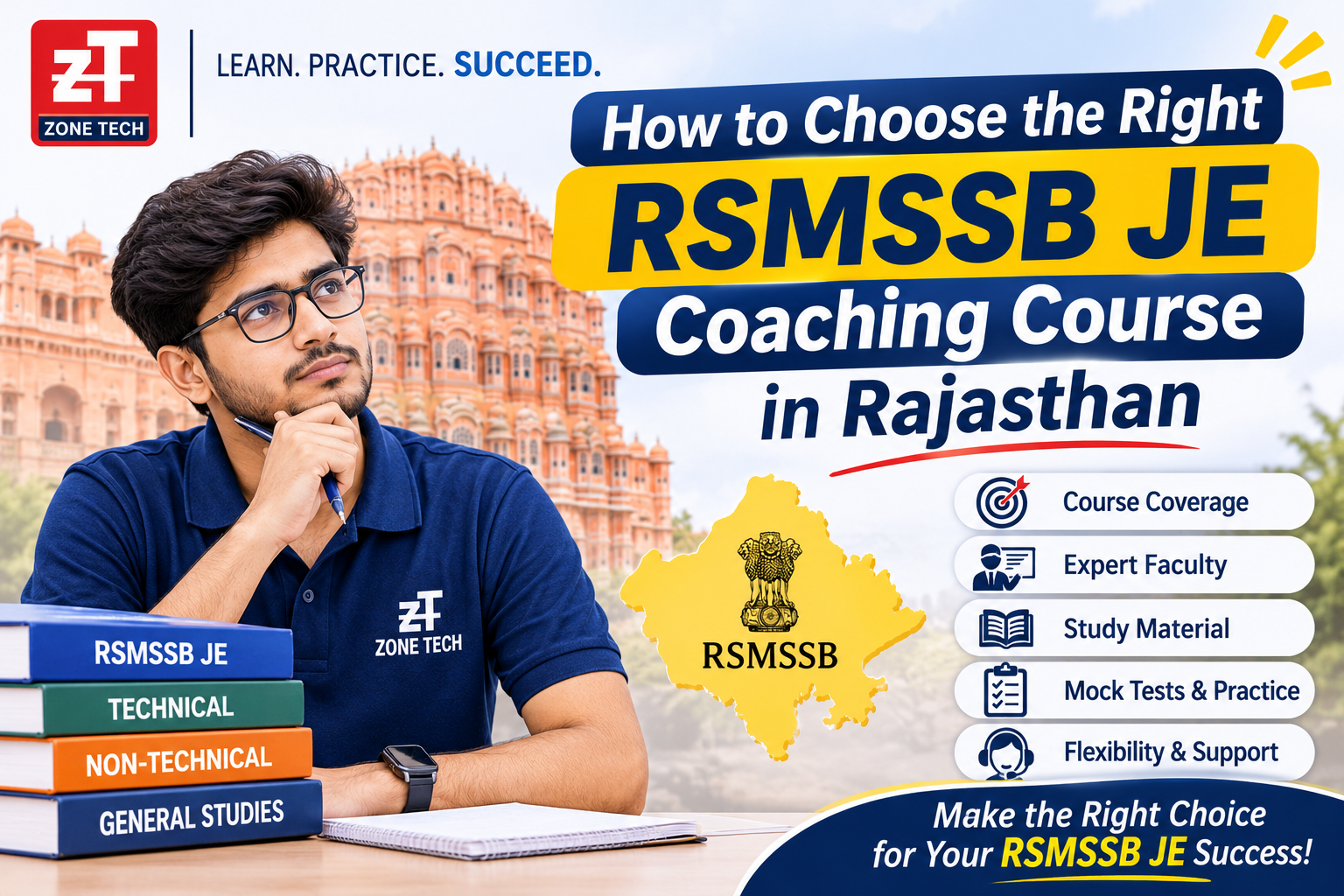
Preparing for the Rajasthan Subordinate and Ministerial Services Selection Board (RSMSSB) Junior Engineer (JE) examination requires a clear understanding of the syllabus, consistent practice, effective time management, and the right learning resources. With competition among engineering candidates, students need to prepare strategically rather than depending only on last-minute revision. Choosing an appropriate coaching course can help candidates organise their studies, understand important topics, practise examination-style questions, and maintain a consistent preparation routine. However, with different coaching institutes, online programmes, and classroom options available, selecting the right course can sometimes feel confusing.
Whether you are a diploma holder or an engineering graduate preparing for the Junior Engineer examination, your coaching decision should be based on your educational background, subject requirements, learning preferences, and available study time. A suitable RSMSSB JE Course should support your preparation according to the applicable examination syllabus and help you identify areas that need improvement. ZoneTech provides an option for students exploring RSSB JE preparation resources and learning formats. This guide explains the important factors to consider when choosing an RSMSSB JE coaching course in Rajasthan, including course structure, online and offline learning, study materials, practice, revision, and preparation planning.
The first step in choosing the right coaching programme is understanding the examination for which you are preparing. The RSMSSB Junior Engineer examination is conducted for engineering-related recruitment, and candidates should carefully review the latest official recruitment notification to understand the applicable eligibility conditions, examination pattern, syllabus, selection process, and other requirements. Different engineering disciplines may have different subject requirements, so students should not assume that every coaching course covers the same content.
Before enrolling in any programme, identify your engineering branch and educational qualification. A candidate with a diploma background may have different preparation requirements from someone who has completed a B.Tech degree. Similarly, the subjects and technical concepts relevant to Civil, Mechanical, and Electrical engineering can vary. Reviewing the official syllabus helps you understand which topics require more attention and whether the selected course is suitable for your examination category.
Students searching for Zone Tech RSSB JE preparation should first compare the available learning options with their intended examination and subject requirements. This makes it easier to select a course that matches their academic background instead of choosing a programme simply because it is popular or advertised frequently.
Course syllabus coverage is one of the most important factors when comparing coaching institutes. A well-planned RSMSSB JE Course should clearly explain the topics included in the programme and how they relate to the latest applicable examination syllabus. Students should avoid enrolling without checking whether the course is designed for their engineering discipline and qualification level.
Begin by obtaining the course syllabus or topic list from the coaching provider. Compare it with the official RSMSSB JE syllabus and identify any missing or additional topics. Pay attention to technical subjects because they form an important part of engineering examination preparation. Students should also check whether the programme addresses non-technical or general sections wherever required by the relevant examination pattern.
A course description should provide enough information for students to understand what they will study. If the syllabus is unclear, ask the institute for clarification before making a payment. You should also confirm whether the programme is updated according to the latest recruitment notification, particularly when the examination pattern or syllabus has been revised.
Students have different learning preferences, daily schedules, and access to coaching facilities. Some candidates prefer attending classroom sessions because they find face-to-face learning easier to follow, while others need the flexibility of studying from home. Understanding these differences can help you decide whether an RSMSSB Online Course or an offline classroom programme is more suitable.
An online course can be a practical option for students who live far from a coaching centre, have other responsibilities, or prefer organising their study hours independently. It may reduce daily travel time and allow students to access learning resources from a suitable location. However, students should check the actual course format before enrolling. Important details include class schedules, access duration, teaching format, available study materials, doubt-resolution arrangements, and whether recorded sessions are included.
An RSMSSB Offline Batch may be more suitable for candidates who prefer a fixed timetable and a classroom learning environment. Attending scheduled sessions can help students maintain a regular routine and follow a planned sequence of topics. Classroom learning may also provide opportunities to discuss questions directly with instructors, depending on the institute's teaching arrangements.
Neither format is automatically better for every student. Your decision should depend on your daily routine, learning habits, travel arrangements, and the actual facilities offered by the coaching provider.
Engineering examinations require more than memorising definitions and formulas. Students need to understand concepts, apply technical knowledge, and solve questions accurately. Therefore, the teaching approach used by a coaching institute should be an important part of your selection process.
When evaluating a course, find out whether lessons focus on conceptual understanding or mainly on completing the syllabus quickly. A useful teaching approach should explain fundamental concepts before moving towards more complex problems. Students should be able to understand why a particular formula is used, how a numerical problem is solved, and how different concepts are connected.
It is also helpful to understand how the institute handles difficult topics. Some engineering subjects require repeated practice and step-by-step explanations. If a student struggles with a topic, the learning programme should provide an appropriate opportunity to review it. Before joining, you can ask whether a demo class, sample lecture, or course orientation is available. This can help you assess whether the teaching style matches your learning preferences.
Study material is another important consideration when choosing coaching for the RSMSSB JE examination. Good preparation involves understanding concepts, revising important information, and practising questions regularly. Students should check whether the selected programme provides study resources that support these activities.
The material should be relevant to the applicable syllabus and presented in a clear format. Engineering notes, topic-wise questions, practice exercises, and revision resources can help students organise their preparation. However, candidates should not assume that a large quantity of study material automatically means better preparation. The relevance, accuracy, and usefulness of the content matter more than the number of pages or documents.
Previous-year question papers can also help students understand the style and level of questions asked in earlier examinations. When reviewing them, students should focus on identifying recurring concepts, understanding question patterns, and recognising topics that need additional practice. However, previous papers should be used as preparation resources rather than as a guarantee of what will appear in the next examination.
A preparation course should encourage students to assess their progress regularly. Studying topics without testing your understanding can make it difficult to identify weaknesses. Practice tests and mock examinations can help candidates evaluate their preparation and develop better examination strategies.
Mock tests allow students to practise answering questions within a fixed time. They can help improve time management, question selection, and accuracy. After completing a test, students should review their answers rather than focusing only on their scores. Understanding why an answer was incorrect is often more useful than simply attempting another test.
Four Important Benefits of Regular Practice
Concept clarity: Identify topics that need additional explanation and revision.
Time management: Learn to distribute available time across different questions.
Accuracy improvement: Understand mistakes and reduce repeated errors.
Progress tracking: Evaluate preparation and identify weaker subject areas.
Before selecting an RSMSSB JE Course, check whether practice tests or assessment resources are included. If they are available, understand their frequency, format, and relevance to the examination. If they are not included, plan to use suitable practice resources independently.
The right coaching course should match your engineering discipline and academic foundation. Candidates preparing for different engineering branches may need different technical subjects, explanations, and practice questions. Therefore, checking branch-specific syllabus coverage is essential before joining any coaching programme.
Students preparing for Civil Engineering should review the technical subjects relevant to their examination syllabus. Similarly, Mechanical and Electrical Engineering candidates should ensure that the selected programme addresses their respective technical requirements. Do not rely on general advertisements that mention RSMSSB JE preparation without explaining which engineering disciplines are covered.
Your academic background also influences your preparation needs. Some students may already have a strong understanding of technical concepts but need more question practice. Others may require a structured explanation of basic topics before moving towards advanced questions. Identifying your current level can help you choose a programme that provides suitable learning support.
At ZoneTech, students exploring Zone Tech RSSB JE preparation should review the course information and confirm that the available programme matches their branch, qualification, and intended examination.
A coaching programme should fit into your preparation timeline. Before enrolling, understand the batch schedule, class frequency, course duration, and topic completion plan. These details help students decide whether they can attend sessions regularly and complete the syllabus with enough time for revision.
Candidates who are preparing alongside college, employment, or other responsibilities may need a schedule that accommodates their existing commitments. Students preparing full-time may prefer a more structured daily routine. In both cases, the programme should offer a realistic study plan that leaves sufficient time for practice and revision.
Do not select a coaching course only because it promises to complete the syllabus in a short period. Completing topics without understanding them may create difficulties during revision and examination practice. Instead, focus on whether the schedule allows adequate time for learning, question-solving, and clearing doubts.
If you are considering an RSMSSB Offline Batch, check the classroom timings and location to understand your daily travel requirements. For an online programme, confirm the session timings and access conditions before making a decision.
Students often encounter difficult questions while preparing for technical examinations. A concept that appears simple during a lesson may become confusing when applied to a numerical problem or an unfamiliar question. This makes doubt-resolution an important factor when comparing coaching options.
Before enrolling, ask the institute how students can raise questions and receive clarification. Find out whether doubts are addressed during classes, through separate sessions, or by another available method. Also check whether students can revisit difficult topics or access additional explanations when needed.
A good learning environment should encourage students to ask questions instead of moving forward with incomplete understanding. Regular clarification can help prevent small conceptual gaps from becoming larger problems during revision. However, the availability and format of doubt support can differ between coaching providers, so students should confirm the actual facilities rather than assuming they are included.
Course fees are an important consideration, especially for students managing their education expenses. However, choosing the least expensive programme without checking its syllabus, teaching approach, and learning resources may not be the most suitable decision.
When comparing coaching fees, consider what is included in the programme. Check the course duration, subject coverage, class format, study material, practice resources, and any additional charges. If you are comparing online and offline options, remember that their pricing structures and facilities may differ.
Students should also ask about payment terms, access duration, cancellation conditions, and refund policies wherever applicable. Understanding these details before enrolling helps avoid confusion later. Instead of focusing only on the advertised fee, compare the overall learning support and suitability of each programme.
Selecting a coaching option is an important part of preparing for a competitive examination. Students need to understand their syllabus, identify their learning requirements, and select a programme that fits their academic background and daily routine. ZoneTech is an option for candidates exploring RSMSSB JE preparation and comparing available online and offline learning formats.
Before selecting a programme through ZoneTech, students should review the available course details and confirm the relevant engineering branch, syllabus coverage, class schedule, course duration, and learning resources. It is also useful to understand the format of the programme and the facilities available for practice and doubt clarification.
Candidates should approach coaching as one part of a wider preparation strategy. Regular self-study, consistent revision, solving previous-year questions, and evaluating performance are equally important. Even a well-structured coaching programme requires students to participate actively and follow a disciplined study routine.
For students searching for an RSMSSB Online Course or an RSMSSB Offline Batch, reviewing the available ZoneTech options can be a starting point for understanding which learning format may suit their preparation needs.
Joining a coaching course is not enough to complete examination preparation. Students need to create a study plan that includes regular classes, independent study, practice, and revision. A realistic timetable helps candidates distribute their time across subjects without neglecting difficult topics.
Start by dividing the official syllabus into smaller sections. Assign study time according to topic difficulty and your existing understanding. After attending a class, revise the topic and attempt relevant questions. This helps reinforce concepts and makes it easier to identify areas that require further explanation.
Keep separate time for revision because previously studied topics can become difficult to recall if they are not revisited. Weekly assessments can help evaluate your progress and identify topics that need more attention. As the examination approaches, focus on revising important concepts, practising timed questions, and improving accuracy.
A practical routine should also include short breaks and sufficient rest. Studying for long hours without a clear plan may reduce concentration. Consistency and focused learning are generally more useful than irregular preparation sessions.
Students sometimes select coaching programmes based on advertisements, popularity, or the promise of quick preparation. These factors do not necessarily indicate whether a course is appropriate for a particular candidate. Before enrolling, compare the actual course details and ask questions about anything that is unclear.
Avoid these common mistakes:
Ignoring the official syllabus: Always compare the course coverage with the latest applicable RSMSSB notification.
Choosing the wrong learning format: Consider whether online or classroom learning suits your daily routine.
Overlooking practice: Check how you will practise questions and evaluate your progress.
Not checking course details: Confirm fees, duration, schedule, access conditions, and available resources.
Another mistake is depending entirely on coaching without independent study. Coaching can provide structure and guidance, but candidates must revise regularly, solve questions, and monitor their own progress. A balanced preparation approach is more practical than relying on a single resource.
1. How do I choose the right RSMSSB JE coaching course in Rajasthan?
Start by checking the latest official syllabus, your engineering branch, course coverage, teaching method, study material, practice resources, batch schedule, and fees. Choose a programme that matches your educational background and preparation requirements.
2. What should an RSMSSB JE Course include?
Students should check for relevant syllabus coverage, clear subject explanations, suitable study resources, practice questions, revision support, and a structured learning schedule. The actual facilities can vary between coaching providers.
3. Is an RSMSSB Online Course suitable for JE preparation?
An online course can be suitable for students who prefer flexible learning or cannot regularly travel to a coaching centre. Before enrolling, check class timings, access duration, course format, and available student support.
4. Should I join an RSMSSB Offline Batch?
An offline batch may suit candidates who prefer classroom learning, fixed schedules, and direct interaction during lessons. Consider the institute's location, class timings, syllabus coverage, and available facilities before joining.
5. Can diploma and B.Tech students prepare for the RSMSSB JE examination?
Eligibility depends on the specific post and the requirements mentioned in the relevant official recruitment notification. Candidates should carefully verify the accepted qualifications, engineering discipline, and other eligibility conditions before applying.
Choosing the right coaching course is an important decision for students preparing for the RSMSSB Junior Engineer examination in Rajasthan. The most suitable programme should match your engineering branch, academic background, learning preferences, and preparation schedule. Before enrolling, carefully compare syllabus coverage, teaching methods, study resources, practice opportunities, student support, course duration, and fees.
Whether you are considering an RSMSSB Online Course for flexible learning or an RSMSSB Offline Batch for a structured classroom routine, focus on the actual learning facilities rather than promotional claims. Review the available options at ZoneTech, confirm the current course details, and select a programme that supports your preparation goals. With consistent self-study, regular revision, focused practice, and a clear understanding of the official examination requirements, you can build a more organised approach to your RSMSSB JE preparation.
Access live classes, recorded lectures, quizzes and test series from your mobile.



Leave a Reply
Your email address will not be published. Required fields are marked *